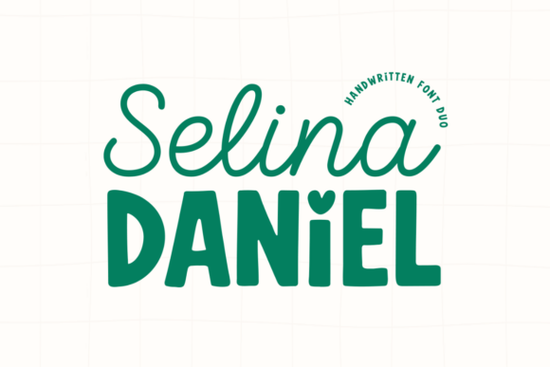
If you need a font duo that pairs a delicate script with a playful sans-serif, the Selina Daniel Duo Font gives you both in one clean package. The script side is light and romantic, while the other is chunky and grounded, so you get instant contrast without juggling two unrelated typefaces.
How can a script + sans-serif duo simplify your branding?
When you’re designing a logo or packaging, you often need a headline that stands out and body text that supports it. Having a matching pair means you don’t waste time mixing fonts from different families that might clash. The Selina Daniel Duo Font handles this by letting you use the script for main headings or delicate signatures, and the bold sans-serif for subheadings or paragraphs. Everything feels cohesive from the start.
For example, a boutique soap brand could use the script on the front label for a handcrafted feel, then set ingredients and descriptions in the sans-serif. The thickness of the sans-serif keeps it readable even at small sizes, while the script adds a personal touch. That kind of hierarchy is essential for small businesses and makers who want a professional look without hiring a designer.
What makes the two fonts feel different yet connected?
The Selina script is a spontaneous, thin stroke that flows naturally – think of a handwritten note from a friend. It has slight irregularity that makes it feel human, not mechanical. On the other side, the Daniel sans-serif is built from thick, rounded shapes with a playful weight. A small detail that stands out is the heart-shaped dot over the “i” in the sans-serif, which brings a bit of whimsy without overpowering the rest of the design.
Both styles share a modern hand-drawn quality, so they don’t look like one is a decorative flourish and the other a stiff generic font. The contrast between light and bold creates a natural visual tension that draws the eye to the most important words. This is especially useful for social media quotes where you want the main phrase to pop and the rest to stay legible.
Which projects benefit most from this font pair?
This duo fits many handmade and feminine-focused projects, but it’s also versatile enough for everyday use. Here are a few real scenarios where the contrast really helps:
- Wedding stationery – Use the script for the couple’s names on the invitation and the sans-serif for dates and venue details. The weight difference keeps the design airy without feeling cluttered.
- Craft or boutique branding – A small candle maker or jewelry designer can use the script on tags or social media stories and the sans-serif for product labels or website buttons.
- Print-on-demand apparel – A t-shirt design with a short quote in the script and a brand name in the sans-serif creates a balanced layout that reads well from a distance.
- Social media graphics – The script works beautifully for featured text in Instagram stories, while the sans-serif can hold longer captions or hashtags without getting lost in the feed.
If you’re used to working with other hand-drawn fonts like the Coastal Delight or Motcha, you’ll appreciate that this duo comes pre-matched, so you don’t have to experiment with pairing.
Do I need any special software to access the extras?
The font set comes with PUA encoding, which means you can access alternate characters, ligatures, and the heart-shaped dot right from the glyph panel in programs like Adobe Illustrator, Photoshop, or even Cricut Design Space. No extra plugins or workarounds are needed. Simply install the font, open the glyph panel, and click to insert variations. This is especially handy if you want to replace the standard “i” with the heart version or add decorative swashes from the script.
Many designers also appreciate that you can copy-paste these extras without any complex steps, so it’s beginner-friendly for hobbyists who are just starting with digital fonts.
What should you check before using this duo in a project?
Before you commit to a design, run through this quick checklist:
- Test readability at small sizes – The script can become hard to read below 12pt, so avoid using it for long paragraphs or tiny labels.
- Pair with neutral backgrounds – The light script can get lost on busy or dark backgrounds, while the sans-serif holds up well almost anywhere. Plan your contrast accordingly.
- Adjust letter spacing for the sans-serif – Because the sans-serif letters are chunky, they might need a bit of extra tracking to avoid looking too tight, especially in all-caps.
- Use the script sparingly – The charm of the script comes from its uniqueness. Reserve it for keywords or names, and let the sans-serif carry the majority of the text.
For more font duos that follow a similar script-plus-sans concept, you might explore Summer Flower or Picky Retro. Each offers a different personality, but the Selina Daniel Duo Font stands out for its romantic-meets-playful tone.
Next step: Download the font duo and try designing a simple quote on a neutral background. Use the script for the heading and the sans-serif for the author name or subtitle. See how the contrast immediately creates a layered look – you’ll have a finished graphic in minutes.
Learn More Stacked Brick Fonts for Bold Graphic Design
 Floral Summer Fonts for Beautiful Design Projects
 Discover Motcha: a Creative Font for Bold Designs
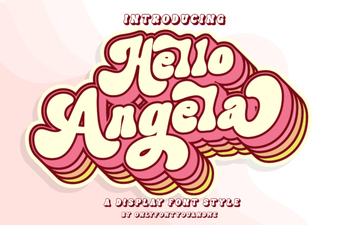 Hello Angela Font for Creative Typography Projects
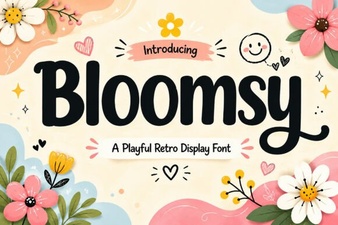 Bloomsy Font: a Creative Touch for Your Designs
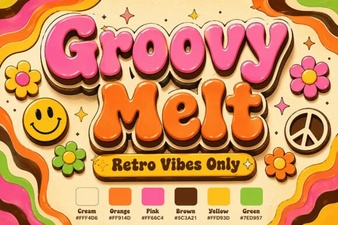 Groovy Melt Font: Creative Design Ideas & Download